What a CommsOS Is & Isn't

The structural response
Most of this site describes a structural problem: organizations adopted AI tools without building the infrastructure layer that makes AI output coherent across people, sessions, and time. Voice converges toward generic. Positioning drifts. Claims go unverified.
The intelligence that once lived inside an agency team or a founder's head was never documented — and AI tools, starting from zero or close to it, on every interaction, have no way to access knowledge that doesn't exist as loadable context.
The structural response? Building knowledge infrastructure.
What it is — and what it isn't
CommsOS isn't brand guidelines. Brand guidelines describe subjective aesthetic preferences — tone should be "warm and approachable," language should feel "bold but accessible." These descriptions aren't testable. Two people reading the same guidelines will produce different interpretations, and neither can be verified as correct or incorrect.
CommsOS isn't content templates. Templates are static artifacts built for specific formats. They become outdated. They don't adapt to context. An organization with fifty templates still lacks the underlying logic that determines which template applies, what evidence a given claim requires, or which voice should write for which audience.
CommsOS isn't a SaaS platform. The knowledge base is a set of markdown files the organization owns. No subscription. No platform dependency. No vendor lock-in. The organization's intelligence doesn't live inside someone else's system.
CommsOS is a set of executable specifications — documented, testable, and loadable into any AI tool as persistent context. The difference is testability. A CommsOS component can be verified against specific criteria. A brand guideline can only be evaluated by subjective judgment.
Three core questions, eight components
The methodology is organized around three questions:
- When should different voices write?
- What language violates differentiation?
- What claims require what proof?
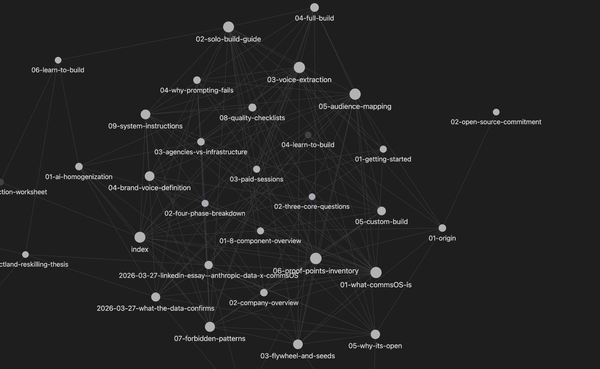
Each question governs a set of documented specifications — eight components total — that together form the knowledge base.
What matters here is the structural logic: every piece of organizational communication already answers these three questions, whether anyone has documented the answers or not. CommsOS makes the answers explicit, testable, and loadable into any AI tool as persistent context.
How the knowledge base works with AI tools
The eight components load into any AI tool as persistent context. The architecture is tool-agnostic — documented in portable markdown files, not locked inside any platform's configuration layer. If the organization switches tools, the knowledge base migrates by copying files.
In practice, a team member producing a grant proposal loads the Company Overview, the relevant voice definition, the funder audience map, the proof points inventory, and the grant-specific quality checklist. The AI tool receives organizational context before the first prompt — without anyone rebuilding it from memory.
What a completed knowledge base looks like
A completed build produces the eight components documented for the organization's specific communications context — all captured from how the organization actually communicates, not described aspirationally.
The knowledge base is designed to work after the builder leaves. A new hire, a contractor, or a different AI tool can load the same system and produce output consistent with organizational standards from the first interaction. The deliverable is infrastructure the organization owns — not an ongoing service dependency.