How Coherent Messages Travel
Messages that carry identity internally don't need supervision through distribution. The same architecture that makes individual outputs coherent makes the methodology itself decentralized and portable.

What happens after the flywheel
Producing a coherent message is only half the problem. The other half is what happens when that message leaves the system and enters the world — forwarded by email, published on social media, quoted in a board report, embedded in a grant portal, adapted for a press release, excerpted by a journalist.
Every distribution channel is an opportunity for identity to degrade. The question is whether the message can survive the journey.
Why traditional distribution degrades identity
In a traditional communications workflow, identity is maintained by supervision. A draft is reviewed before publication. A brand manager approves social posts. An editor checks the press release against the style guide. A senior team member reads the board packet before it ships.
This works as long as every piece of content passes through every checkpoint. In practice, it rarely does.
The failure isn't carelessness. It's that the identity was never in the message — it was in the review chain. Remove a link in the chain, and the identity degrades. The more distribution channels an organization uses, the more links the chain needs, and the more opportunities exist for a link to be missing when a message ships.
Every growing organization we've worked with hits this problem. The content volume outpaces the review capacity. Messages start going out without full supervision. And the organization discovers that unsupervised messages sound different from supervised ones — because the identity was living in the supervision, not in the content.
How seeds solve the distribution problem
Because the flywheel embeds identity during production, a seed can be forwarded, quoted, excerpted, adapted, and redistributed without requiring someone to verify that it still sounds like the organization at each step. The identity isn't in the review chain. It's in the message itself.
The audience mapping component functions as dispersal logic — messages are shaped for their destination before they leave the system. Each message arrives already calibrated for its audience, not because someone manually adjusted it for the channel, but because the knowledge base shaped it during production.
This doesn't eliminate editorial judgment. It changes what editorial judgment does. The knowledge base handles consistency. The human handles meaning.
The same architecture at the methodology level
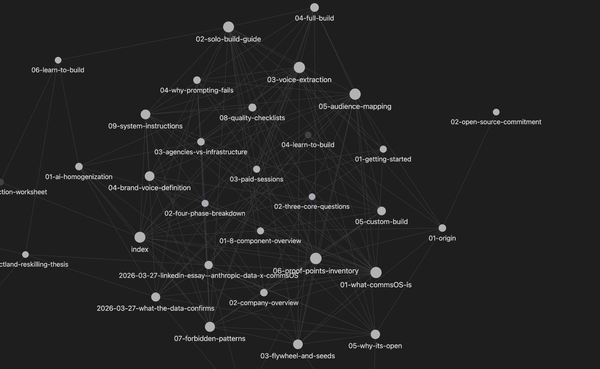
The seed principle applies to the methodology itself. Each CommsOS implementation is independent — a knowledge base built for a specific organization, operating autonomously. No central platform connects them. What connects them is the shared methodology.
The architecture is mycelial in a specific, structural sense: patterns discovered in one implementation inform the methodology documentation, which improves subsequent builds. A forbidden pattern identified in a nonprofit context — say, the discovery that a particular framing of community voice consistently triggers AI tools to produce deficit-based language — gets documented in the methodology and prevents the same failure in future implementations across different sectors.
The network gets denser rather than taller. More implementations produce more pattern data, which refines the methodology, which improves the next build. No single node's failure affects the others. Knowledge transfers laterally through shared documentation, not vertically through a central authority.
What this architecture defends against
AI platforms are building organizational context features — custom GPTs, Claude projects, platform-hosted knowledge bases. These features are useful. They're also vendor-controlled. If the platform changes pricing, deprecates features, or shuts down, the organization's communications infrastructure goes with it.
The portable knowledge base is the source of truth. Platform-hosted versions are convenience layers that load from it. This isn't an argument against using platform features — it's an observation about where the authoritative version of organizational intelligence should live.