The CommsOS Stack

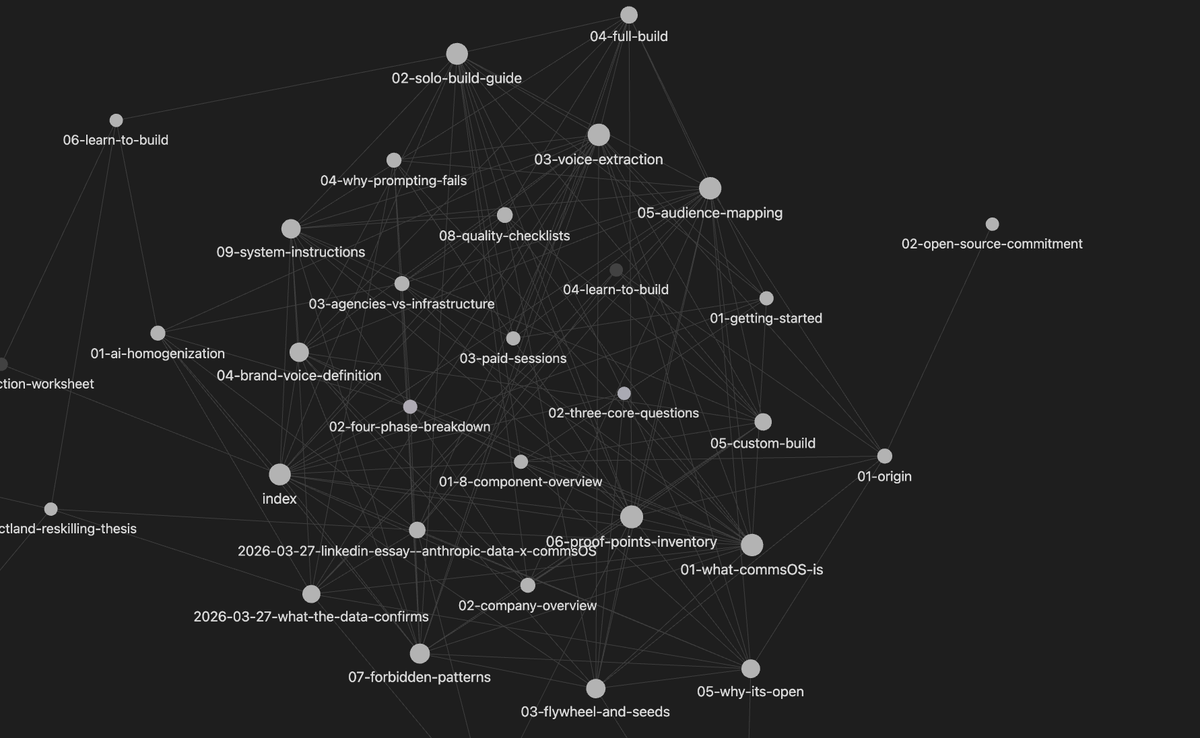
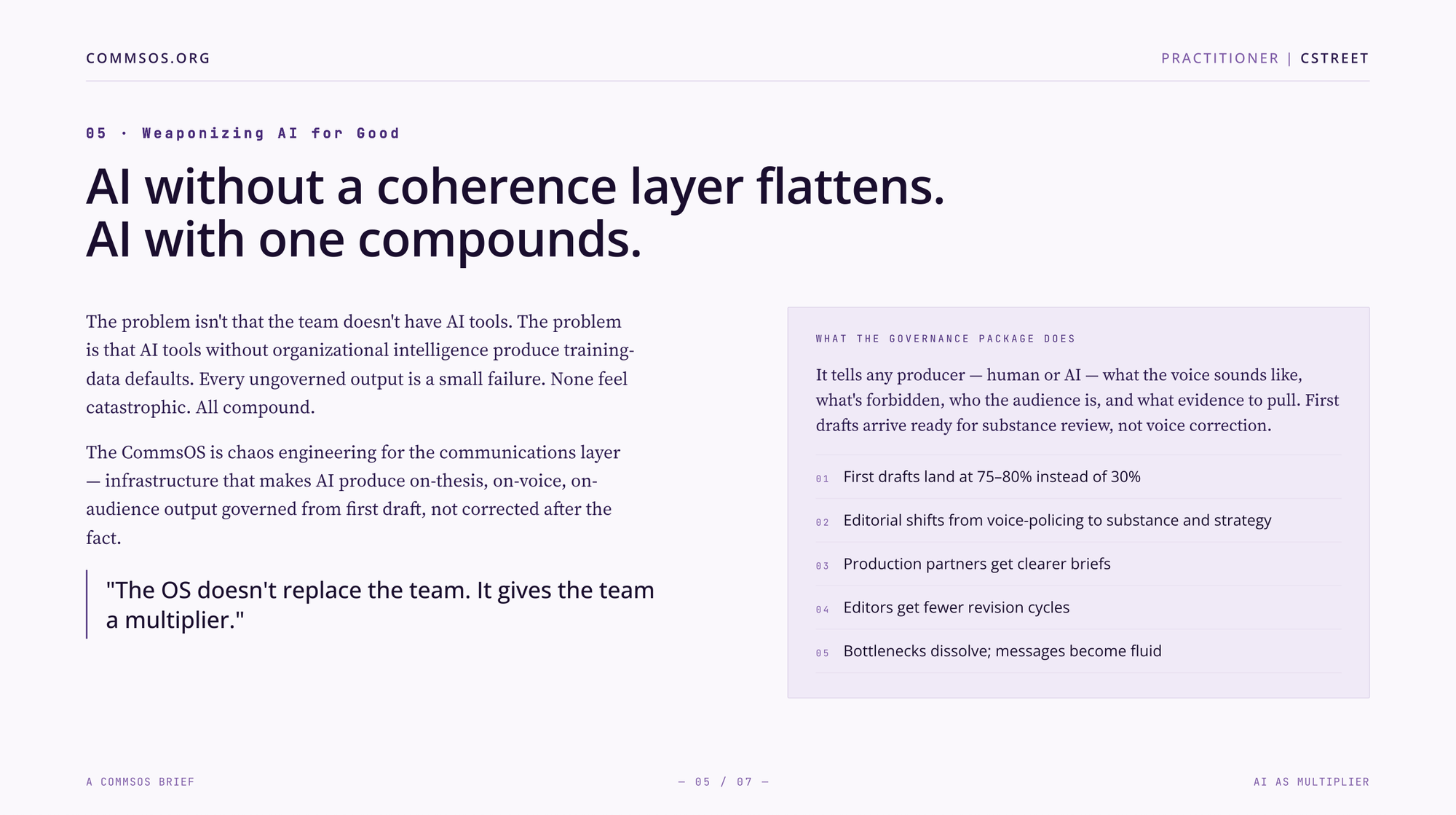
The communications layer of any mission-driven organization in 2026 resembles a dumpster fire behind a Kinko's that someone tried to put out with a garden hose of AI sludge. The fire burns as the hose spreads the chaos. Nobody programmed the hose to understand what the building was for, and now the grant proposal reads like chatbot slop, the contractor deck contradicts the website, and the Slack channel where strategy went to die has three hundred unread messages nobody will ever open.
Bootstrapped teams — chronically under-resourced, already failing to staff for what the mission demands — now produce their own AI content on top of all of it. The noise compounds faster than Gremlins in water after midnight.
The agencies supporting them absorb triple the volume at the same retainer while their own business model melts underneath them. And a whole generation of knowledge workers carrying decades of domain expertise watches tools that trained on Reddit flatten what took them a career to build.
The methodology to fix this already exists. One architecture and four layers of scope, that's it. A governance system that keeps the human layer activated — because the humans carrying decades of expertise amplify through the system, and AI operates inside a knowledge base that somebody built before turning the tools on, not panic-corrected after the grant report was already due.
For the underlying mechanism — how a raw idea moves through the components and emerges coherent — The Flywheel and the Seeds covers it. For the structural problem, The Four-Phase Breakdown Cycle maps the territory.
What holds at every layer
The governance layer separates a CommsOS from brand guides, prompt templates or messaging frameworks. An OS carries voice logic, positioning constraints, and validation frameworks — and governs any producer touching the communications, whether that producer writes on staff, contracts through an agency, or generates a first draft through an AI tool. The system tells each producer how the voice moves, what language to avoid, the audiences to address, and the evidence to generate an accurate and compelling narrative.
Without a shared knowledge base, every partner team entering a project rebuilds the host's voice from a variable memory source. A grant proposal sounds acceptable, but fails to represent the organization properly.
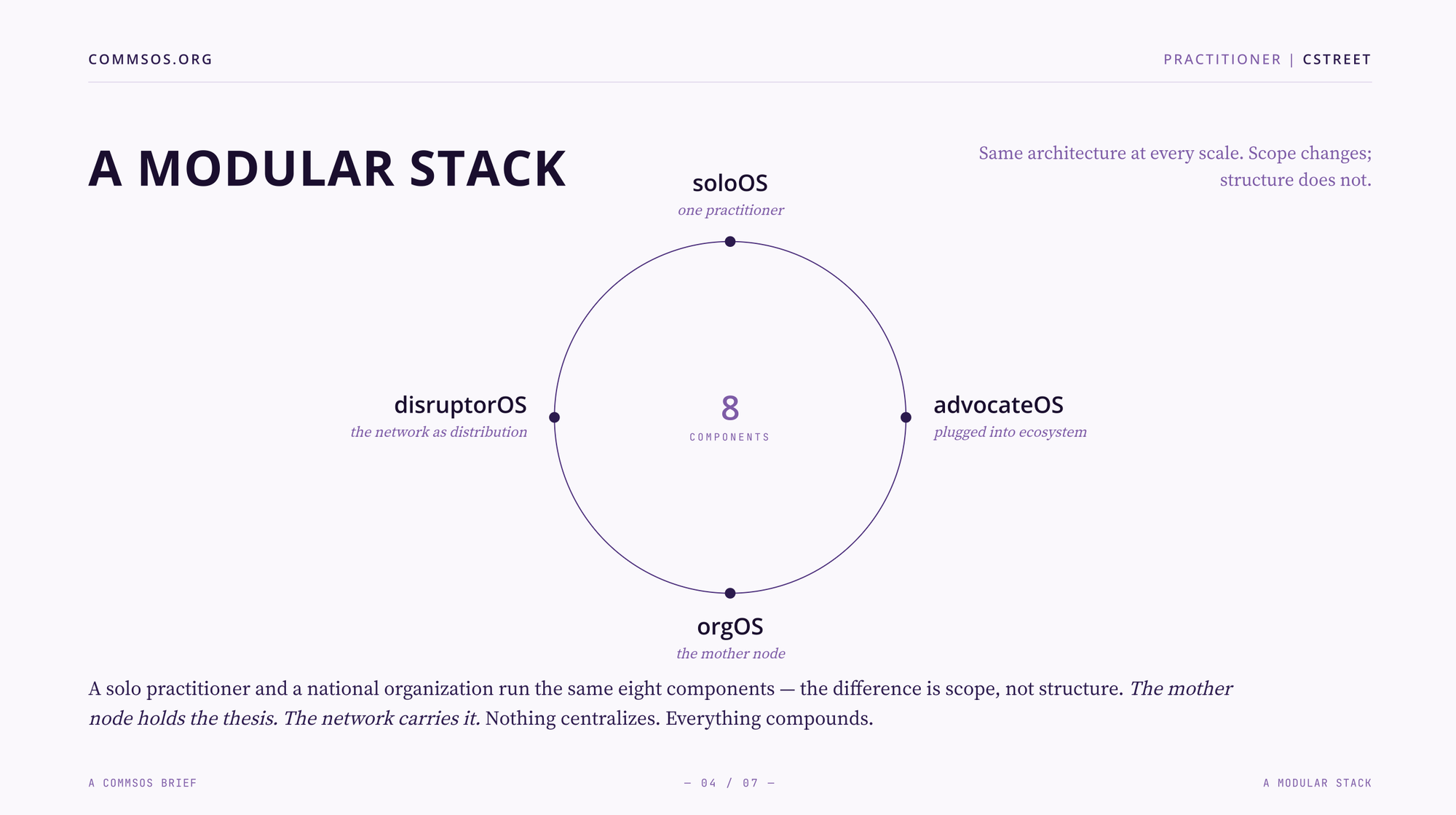
The same eight components hold at every layer. What changes across the stack: scope — the surface area of the communications, the number of audiences, and the connective tissue between nodes. A solo practitioner runs the same components a national organization runs, because the architecture operates as modular rather than hierarchical.
The mother node holds the space for a thesis to emerge. The network carries the seeds of that thesis outward. Each cycle of emergence and outreach builds on the last and strengthens the thesis.
soloOS
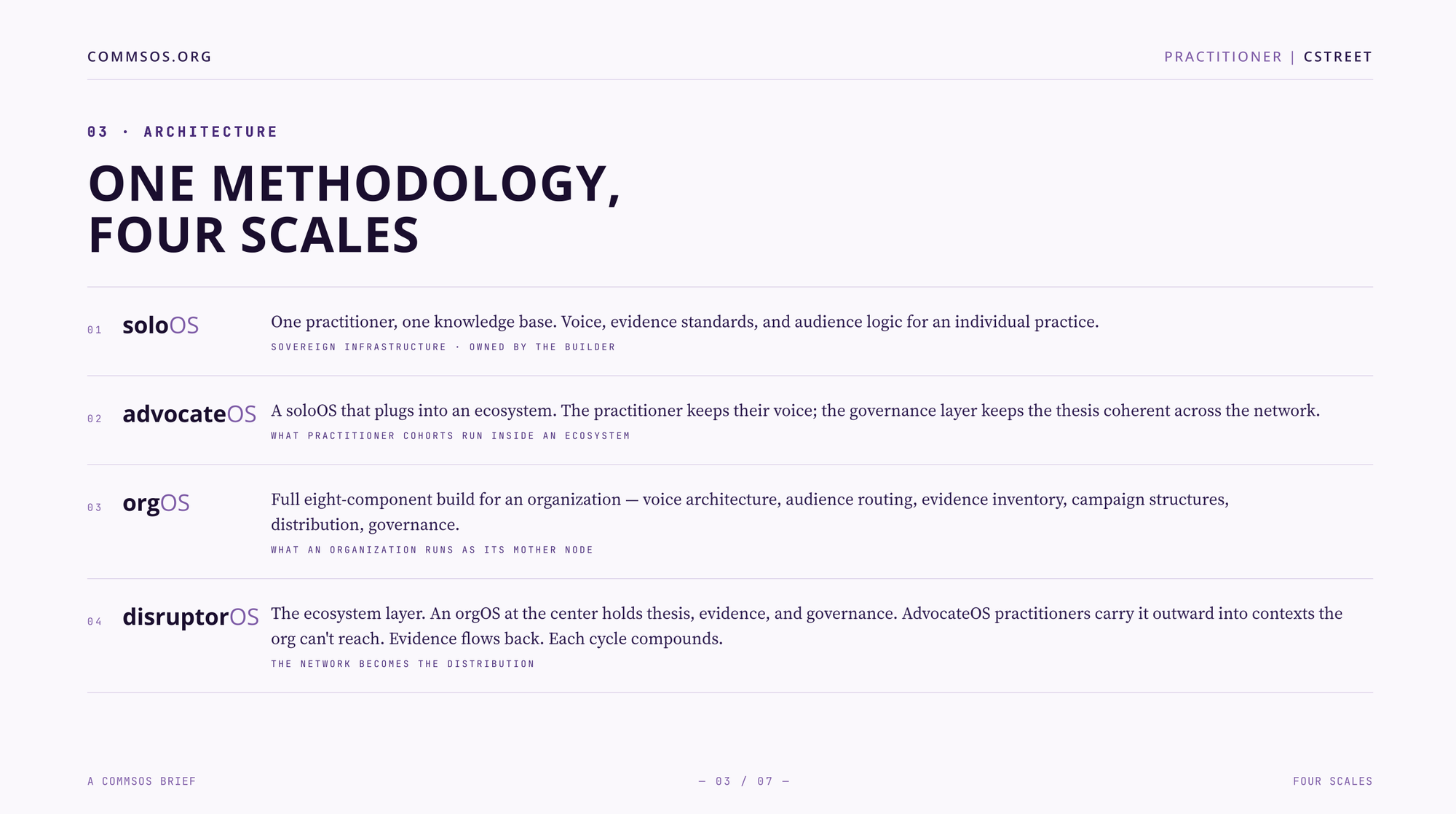
Every CommsOS build starts here, regardless of the intended destination. The soloOS runs the full eight-component methodology at the scale of a single practitioner — one knowledge base carrying voice, evidence standards, audience logic, and validation frameworks for one person's practice, personal or professional.
The soloOS build does more than warm the practitioner up. The build teaches the architecture, because the practitioner encounters every component in the process of standing up their own system. When that practitioner later works inside a larger build — an organization's CommsOS, an advocate ecosystem — the components register immediately, because the practitioner already built a system governing their own work.
In partnered ecosystems, founders, senior subject-matter experts, and principal advisors often keep a soloOS running for their own writing even after the host organization reaches production on its own CommsOS. The solo build functions as the practitioner's own coherence layer. Neither replaces the other — the two connect.
Author's note: I first spun this article based on just the deck images in the post and asked Opus 4.7 to whip up a post. It sucked. Good enough to maybe publish if I didn't know better. But I do. I gave the chat no context or persistent coherence. Duh. So, I rebuilt the context from our commsOS server in Cowork, added a transcript of me walking a team through that deck on a call last week and then made multiple passes using my cstreetOS to give the article some soul. 4.7 is the voice of an engineer trying to sound human– it's not, and never will be. The ghost in my machine was still just slightly off and I wanted to prove my theory rather than write from scratch. So, I copy edited this whole article old school, line by line rewrites. Then I asked chat to compare the two drafts and make a style guide for future essays. The next article will now have framework that gently touches into my cstreetOS for the human layer and then returns to its mother node for publication.
advocateOS
The advocateOS emerges when a soloOS plugs into a larger ecosystem without surrendering the practitioner's own voice. The advocate keeps their personal audience and their own positioning — the voice their readers already recognize — and layers in the host organization's CommsOS when speaking on behalf of the ecosystem.
Two modes run side by side. When the advocate writes from their own seat, the soloOS governs. When the advocate speaks for the larger mission, the host organization's governance layer engages — voice logic, positioning constraints, forbidden patterns specific to the ecosystem. The practitioner decides which mode to operate; the system keeps each one coherent.
The handshake between the two modes makes coordinated coalition work possible without collapsing into centralized message control on one side or scattered freelancing on the other. The advocate pushes the boundaries of what their own voice can say, and the host gains distributed reach without losing positioning. Both sides know the line because the governance layer documents it rather than leaving positioning to informal judgment calls.
orgOS
At organizational scale, the CommsOS becomes the mother node — the canonical knowledge base the ecosystem coheres around. The mother node runs the full eight-component build: voice architecture, audience routing, evidence inventory, campaign structures, distribution logic, and governance — all operating across a team producing communications daily.
Active builds include regulated healthcare and edtech ecosystems running organization-wide deployments serving teams of ten to twenty people across a dozen audience types. The methodology handles the complexity because modular components do their job whether the team numbers two or twenty, and the governance layer scales without requiring a single editor to police the voice.
When a partner agency, a marketing team, or a communications collaborator joins a project where the host runs a CommsOS, the mother node holds the system they actually produce inside of. Their drafts pull from it, their work gets measured against it, and the forbidden patterns library governing their language belongs to the host — not whatever house style they brought through the door. The orientation a partner team needs at that moment matches exactly the walkthrough this post delivers.
disruptorOS
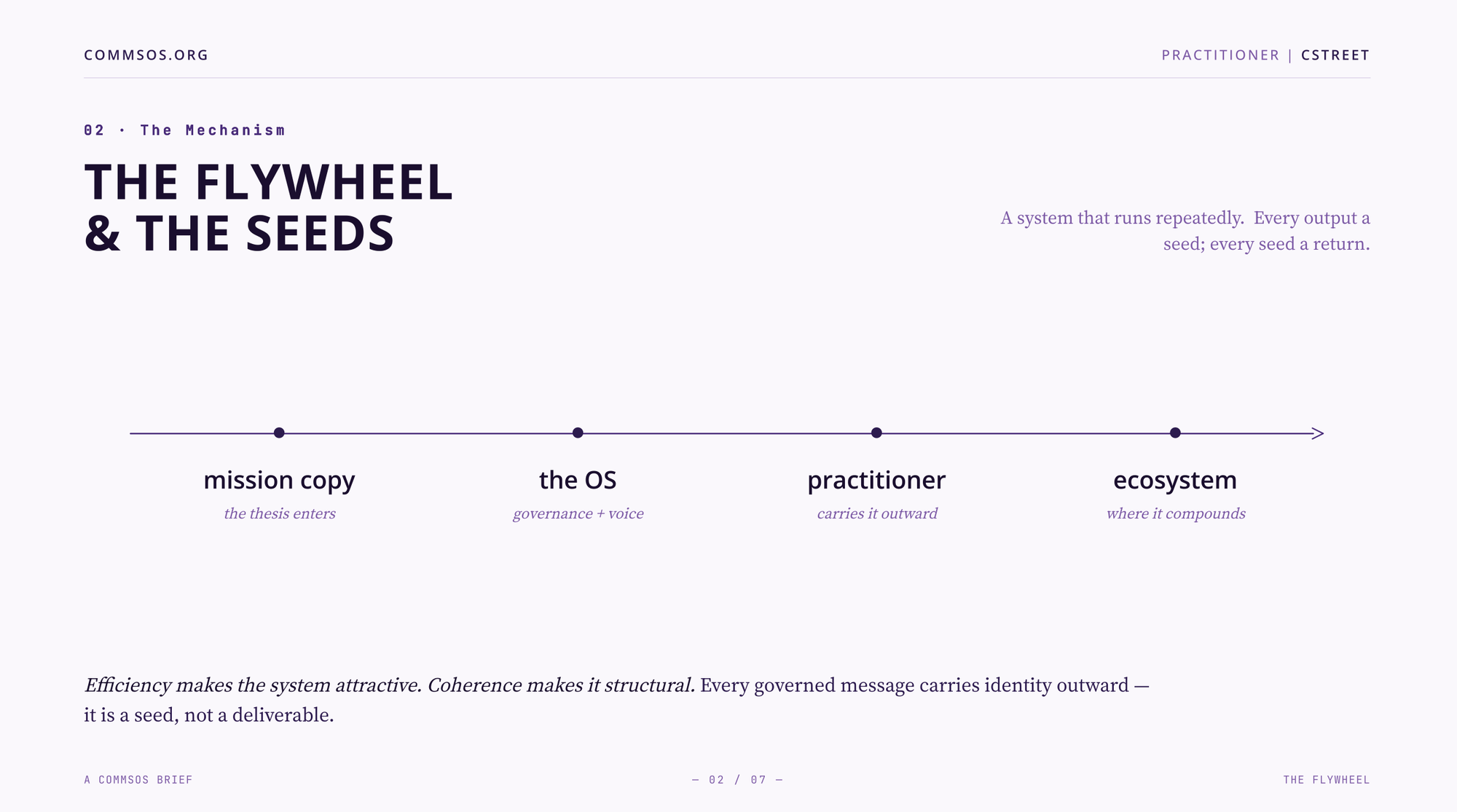
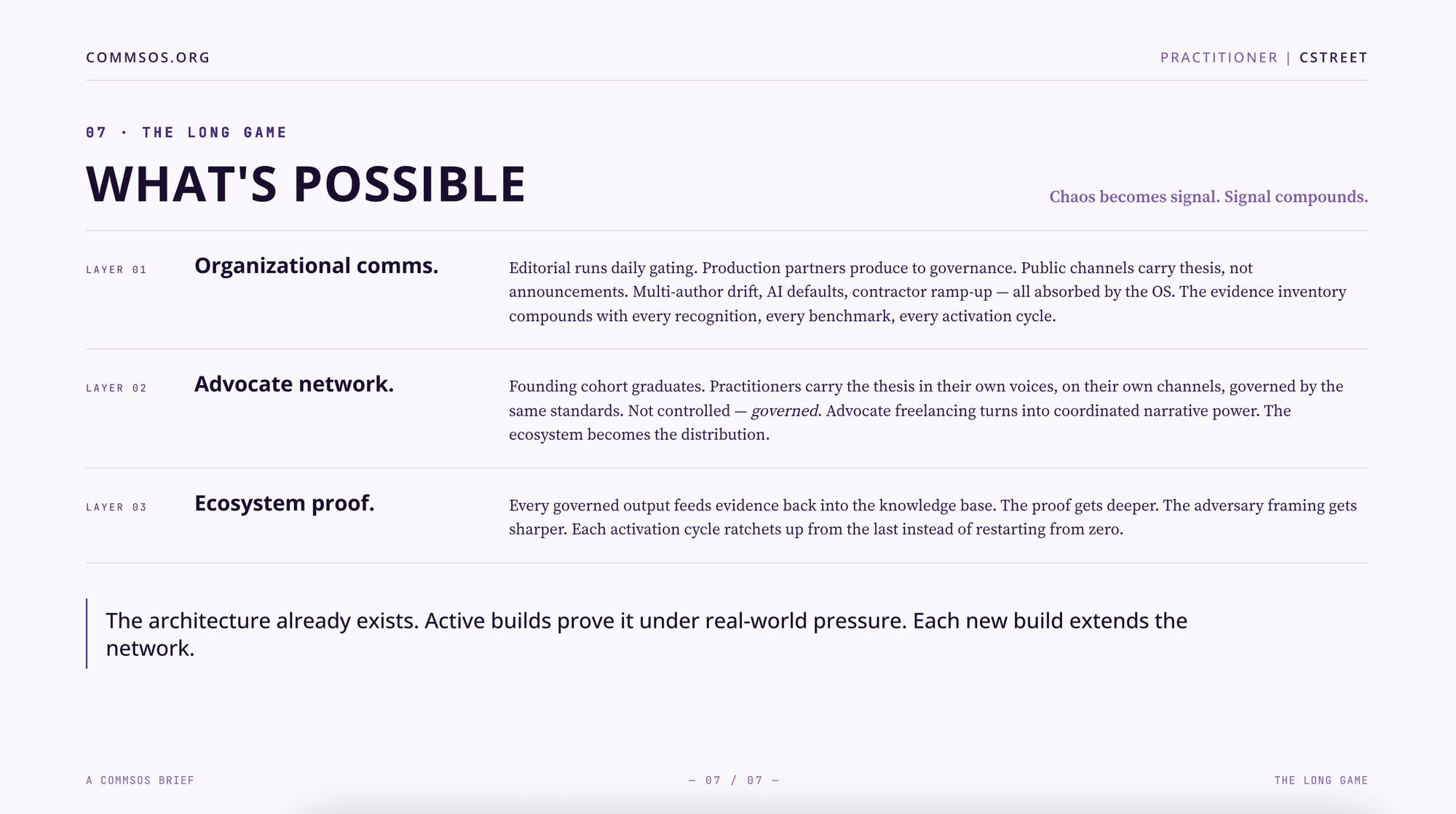
At the largest layer, the ecosystem itself operates as the system. An orgOS sits at the center as the mother node, with hundreds or thousands of advocateOS nodes attached — each one independent, each one coherent with the whole because the components governing voice, positioning, and validation flow from a shared source.
Once the mother node reaches production and credentialed practitioners run their own systems attached to it, the ecosystem becomes the distribution. Content stays coherent across the network because every node loads the same governance layer. The practitioners own their data, the methodology functions as documented commons, and no vendor sits in the middle extracting rent for the privilege of letting the ecosystem cohere.
AI deployed inside a mission-driven ecosystem looks different when practitioners built the ecosystem for impact rather than extraction. The AI tools operating inside each node — solo, advocate, organizational — produce on-thesis, on-voice, on-audience output because practitioners built the knowledge base governing them BEFORE turning the tools on, not after.
Where to go next
Practitioners who want to learn the methodology by building a soloOS on their own work can join a cohort currently in development. The newsletter announces openings first.
In the meantime, poke around the Methodology section of the site, grab a friend or two and start making a mess together as an experiment in soloOS community building.